
When a Yard Drain Needs a Custom Grate Size
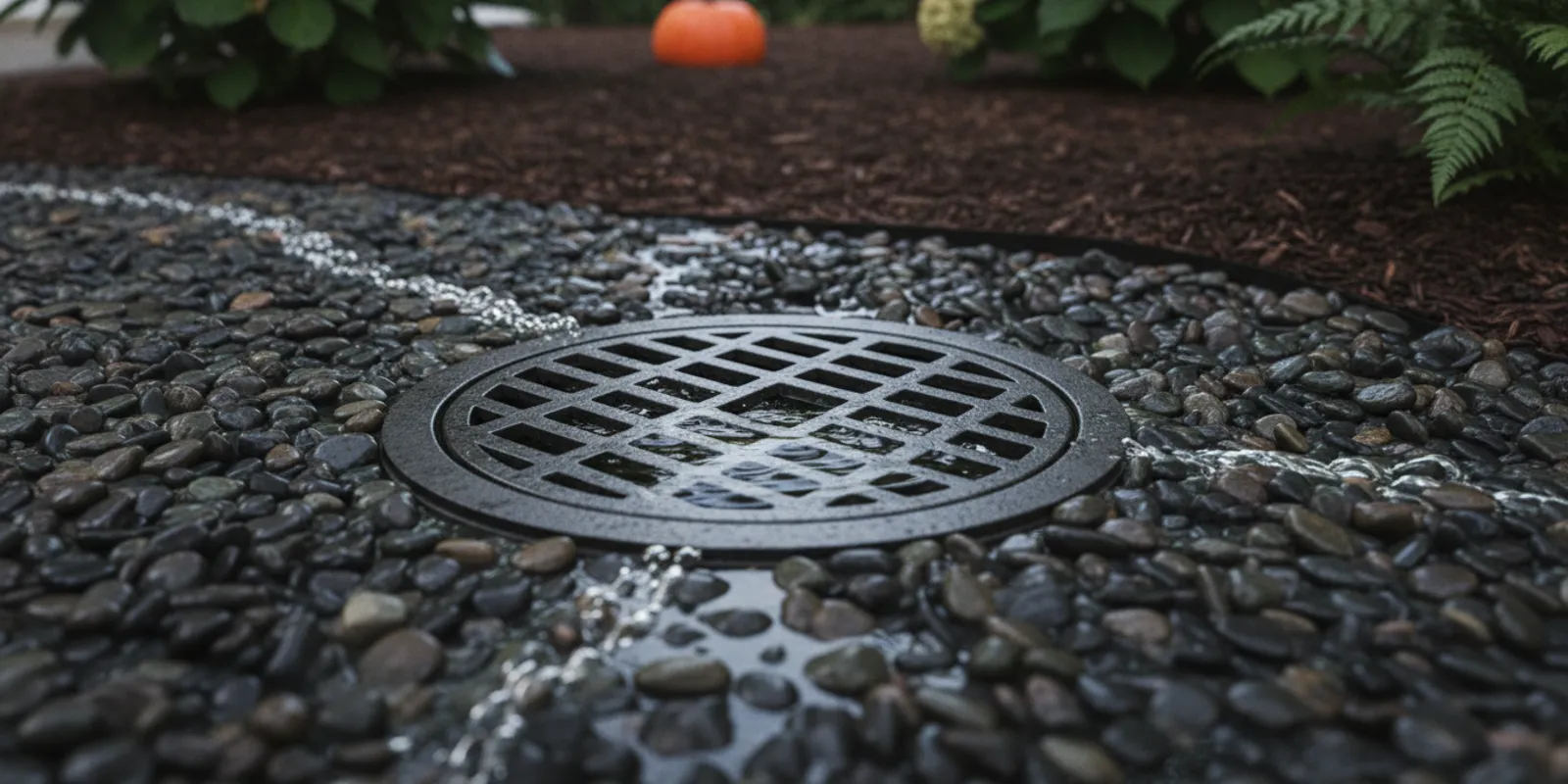
When a yard drain needs a custom grate size, the question is not simply whether a cover looks close to the opening. The grate must rest securely on its frame, allow water to enter, and suit nearby debris and foot traffic. If a standard cover rocks, slips, or leaves an unsafe gap, measure the frame and observe the water path before deciding what to replace.
Request an area drain assessment today
When a yard drain needs a custom grate size, what should you check first?
Start by deciding whether the grate is the problem or only the visible part of a larger one. In customer-facing service language, yard drains are also called area drains. Clear loose surface material if it is safe, then inspect the support edge from above. A replacement cover cannot repair a cracked frame, a loose drain body, a blocked pipe, or a surface grade that sends runoff past the inlet.
Look at the drain during ordinary conditions as well as after rain. A grate in a planting bed may collect leaves, mulch, and soil. One at a patio or walkway may also need to remain steady under regular foot traffic. A cover that is almost the right size can still slide or tip if it does not bear evenly on the frame.
- Check for movement. A grate that rocks, shifts, or drops into the opening may not be supported correctly.
- Inspect the frame. Cracks, missing supports, corrosion, loose concrete, or settled soil suggest that the support itself needs attention.
- Notice the gap and level. A gap can admit larger debris or create a trip or wheel hazard. A raised edge can catch feet; a deep recess can hold water.
- Watch the water path. If runoff bypasses the inlet or stays pooled after entering, sizing may not be the only concern.
Do not force a cover into place or assume every unusual opening needs a made-to-order part. Some products have adjustment features, and a product's nominal dimensions may not describe the exact opening it fits. Compare the manufacturer's fit information with the actual frame, and do not use a cover that cannot sit securely.
When a yard drain needs a custom grate size instead of a standard cover
A custom grate is worth considering when the frame is sound but has an unusual shape or dimensions that do not match a suitable standard cover. Measure before ordering. If the frame is broken, uneven, or moving, first determine whether it can support any replacement. Matching a grate to an unstable frame can solve the wrong problem.
Imagine a rectangular opening that is slightly wider at one end because an old concrete edge is irregular. A measurement taken only across the narrow end could produce a cover that falls through at the wider end. A cover selected for the widest point might instead overlap the frame or sit proud of the walking surface. Several measurements help reveal the mismatch before a part is ordered.
A standard cover may be appropriate when the frame is intact and the opening matches a product's stated dimensions and support requirements. An adjustable product may address a small variation if it still seats evenly and securely. A custom cover becomes more likely when a notch, unusual angle, nonstandard shape, or uneven dimension prevents those options from fitting.
Think about the use of the area before selecting a part. A grate in an ornamental bed has different practical demands from one in a route used by people moving bins or carts. Do not infer load capacity from a grate's material or appearance; use the product specifications for the intended location. If the cover repeatedly shifts, treat that as a fit or support concern rather than a cosmetic defect.
How should you measure a grate and its supporting frame?
Measure the frame and opening, not just the old grate. The old part may be warped, damaged, or incorrectly sized. Remove loose debris from the top only if it is safe to do so, and identify the stable ledge where the grate actually rests. Do not reach into the drain or lift a heavy cover without suitable help.
- Record the shape. Note whether the opening is round, square, rectangular, or irregular. Sketch corners, notches, and edges that differ from one another.
- Measure the clear opening. For a rectangle, measure the inside length and width. For a circle, record the inside diameter. Take each measurement at more than one point.
- Measure the outside frame. Record overall dimensions and mark which edges support the grate. Label inside and outside measurements so they cannot be confused.
- Check the bearing ledge. Measure the width and continuity of the support surface. A cover needs sufficient, even support so it does not rock or drop through.
- Note depth and finished level. Describe whether the grate sits flush, recessed, or raised compared with nearby paving, soil, or landscaping. Record obstructions such as edging, pavers, or a wall.
- Describe how the area is used. Note foot traffic, carts, vehicles, runoff from a slope or roof, and nearby leaves or gravel. These conditions help determine whether a product is suitable.
- Take photos with scale. Photograph straight down and from the side with a tape measure or ruler visible. Include the surrounding surface and any damage.
Write down the units and the position of each measurement. If the frame is not square, make a simple sketch and label which edge faces the house, patio, or slope. For example, mark “patio side” and “garden side” instead of sending an unlabeled list of four numbers. That detail helps a supplier or service professional understand which dimension belongs to which edge.
Record how water behaves during ordinary rain or watering, without creating a flood to test the system. Does water reach the grate, pool around it, enter slowly, or disappear and then return? Note whether the grate is covered by debris at that time. These observations matter because a cover's dimensions tell only part of the drainage story. Do not dismantle the drain or probe the pipe to gather information.
A practical measurement example
Suppose the old grate measures about the same as the visible opening, but one corner has settled and the frame is lower than the paving. First check whether the apparent opening changes from one side to the other and whether the ledge is still continuous. If it is, compare the actual support dimensions with a product's fit range. If the edge is crumbling or a corner moves, pause the size search: a new cover cannot replace missing support. Share the sketch and photos with the person assessing the drain, rather than ordering from the old grate's dimensions alone.
Which site conditions influence a custom grate decision?
Dimensions are essential, but a useful grate also has to match its surroundings. An inlet in a low planting bed may encounter leaves and soil. One beside a paved surface may receive faster runoff and more foot traffic. Consider the whole location instead of choosing by appearance alone.
- Runoff area: A low point receiving water from a roof, slope, or broad paved area may face more flow than a small garden corner. Note where the water originates and whether it arrives as a sheet or a concentrated stream.
- Debris exposure: Trees, grass clippings, gravel, and mulch affect how quickly openings can become covered and how often surface clearing may be needed.
- Traffic: A walkway, driveway, or equipment route calls for a stable cover suited to the actual use. Check product specifications rather than guessing at load capacity.
- Surface grade: The nearby surface should guide water toward the inlet without leaving a raised edge or a deep pocket around it.
- Drain condition: Slow drainage after water passes through the grate can indicate a blockage or a problem farther along the system.
Opening pattern also involves a tradeoff. Smaller openings may catch more leaves and debris at the surface and require more frequent clearing. Wider openings may admit larger material or leave an unsuitable gap, depending on the location and product. The right balance depends on the intended use, surrounding material, and maintenance needs; there is no single pattern that suits every yard.
Stormwater is affected by more than the inlet cover. The U.S. Environmental Protection Agency provides general information about environmental and water programs at its official website. For a specific property, use site conditions and the drain's actual performance to guide the assessment; general public information does not determine an individual grate size.
How do standard, adjustable, custom, and repair options compare?
Use the comparison below as a way to organize the decision, not as a substitute for checking product fit or frame condition. The right option depends on what the measurements and inspection reveal.
| Option | When it may fit | What to verify | Limitation |
|---|---|---|---|
| Standard replacement | The frame is sound and matches a listed product size | Clear opening, bearing edge, shape, and secure seating | Nominal size may not match actual dimensions |
| Adjustable cover | A small size variation can be accommodated | Adjustment range, support, and level, stable fit | Cannot correct a broken or loose frame |
| Custom grate | Irregular shape or no suitable standard option | Multiple dimensions, intended use, debris, and finished level | Requires accurate specifications and may take longer to obtain |
| Frame or drain repair | Frame moves, cracks, settles, or water still drains poorly | Support, visible water path, outlet, and grading | A new grate alone will not fix an underlying fault |
Consider two contrasting cases. In the first, a cover is too small, but the concrete frame is intact and evenly supported. The next step is to compare the measured opening and ledge with standard product specifications. A secure standard option may fit, so custom fabrication could be unnecessary. In the second case, a larger cover seems to span the opening, but a corner of the concrete edge is broken and the grate tilts. The larger cover does not restore the missing support; the frame needs assessment before a grate is selected.
A third case illustrates why water symptoms should be considered separately. If a correctly seated grate is clear but water remains around it, changing the grate pattern may not help. Observe whether water reaches the inlet and whether it passes through. A surface-flow issue, blockage, or damaged connection calls for a different diagnostic question than unusual grate dimensions.
What should you do if the grate is damaged or water still collects?
If a grate is cracked, shifts when touched, or leaves an exposed opening, keep people and wheeled equipment away until it is made safe. Remove only loose debris that can be reached safely. Do not pry a stuck cover with improvised tools, enter a stormwater structure, or use chemicals as a substitute for finding the cause of a drainage problem.
During ordinary rain, note whether water flows toward the drain, pools beside it, or enters and then drains slowly. Check from the surface for visible debris at the inlet. If water enters but backs up, a pipe obstruction or downstream issue may be involved. If it never reaches the grate, surface grade or inlet placement may be relevant. If more than one drain is affected, record that too; a wider pattern can help distinguish a single inlet problem from a larger drainage concern.
Measurements, photos, and a concise symptom description make an assessment more useful. Conejo Bros Plumbing serves residential and commercial customers in Thousand Oaks, the Conejo Valley, and Ventura County. Learn about yard drain service and the company's drain services. If the water is passing through the grate but not clearing as expected, drain camera inspection and drain jetting are additional drain-service topics to discuss when determining a next step.
How can you maintain a replacement and spot recurring problems?
After a replacement, check from the surface that the grate rests evenly and does not move under normal contact. Keep leaves, mulch, and loose soil from covering the inlet. After heavy rain, look for new gaps, shifted edges, or a change in where water pools. A quick visual check can reveal a developing support concern before it becomes a larger opening.
Keep maintenance appropriate to the setting. A drain beneath trees may need more frequent surface checks than one in an open paved area. Avoid placing loose mulch or gravel where it can wash into the inlet. A fine screen can catch debris, but it can also become blocked; do not add one without considering whether it could obstruct runoff during rain. If you clear the grate, remove surface material only and avoid pushing debris down into the drain.
For a property manager or business owner, keep a simple record for each inlet. Include its location, date checked, recent weather, debris found, grate movement, and whether water cleared normally. If the same inlet backs up after each storm despite surface cleaning, repeated clearing of the grate may not address the cause. Photos from the same position can show whether soil, paving, or a frame has shifted over time.
When the surface grate is intact but drainage remains slow, related information about blocked drain cleaning, professional drain clearing, and drain cleaning and hydro jetting can help frame questions about the connected drain. The symptoms and system condition determine which assessment is relevant; a grate replacement is not a universal fix.
When does an area-drain issue involve public works or a larger project?
Some drainage concerns are connected to work beyond a private yard, such as a street lateral, a public right-of-way, or a property conversion. In those cases, the grate question may be only one part of coordination. Conejo Bros Plumbing has a public-works specialist section covering DWP and city public works, street-lateral replacement, traffic control, City planning and permits, septic-to-city-sewer rerouting, and pre-construction plumbing bids.
For example, if a property project changes how drainage or sewer connections meet public infrastructure, do not assume that choosing a new grate resolves the whole scope. Clarify the boundary between the area drain, private piping, and any public-work requirements before construction begins. A plan, site photos, and a description of where water or wastewater travels can help start that conversation. This is a separate coordination issue from selecting a cover for an intact private frame.
Frequently asked questions
Can I measure the old grate and order the same size?
Use it as a reference, but measure the frame, clear opening, and supporting ledge too. The old grate may be warped or may not have been the correct fit. Check the replacement product's fit details against the actual dimensions.
Does a custom grate fix a drain that backs up?
Not necessarily. A custom part addresses dimensions and fit. A blockage, damaged connection, poor grade, or inadequate drainage path may need separate attention. Note whether water reaches the grate and whether it passes through.
Should an area-drain grate sit flush with the ground?
It should be stable and suitable for its surroundings, without an unsafe raised edge or a deep recess that traps water. The correct level depends on the frame and local surface grade, so assess the adjoining surface rather than relying on appearance alone.
What information should I share when requesting help?
Share the opening shape, inside and outside measurements, bearing-edge details, photos, and where water collects. Explain whether the cover moves, is damaged, becomes buried in debris, or seems stable while water still drains slowly.
Is a custom grate always better than an adjustable one?
No. An adjustable product may suit modest variation if it remains securely supported and meets its product specifications. A custom grate is a possibility when a sound frame has dimensions or a shape that standard and adjustable products do not accommodate.
Request an area drain consultation today
A well-fitted grate is only one part of reliable yard drainage; matching it to the frame and observing the water path helps identify the appropriate next step.