
Yard Drain vs French Drain for Conejo Valley Homes
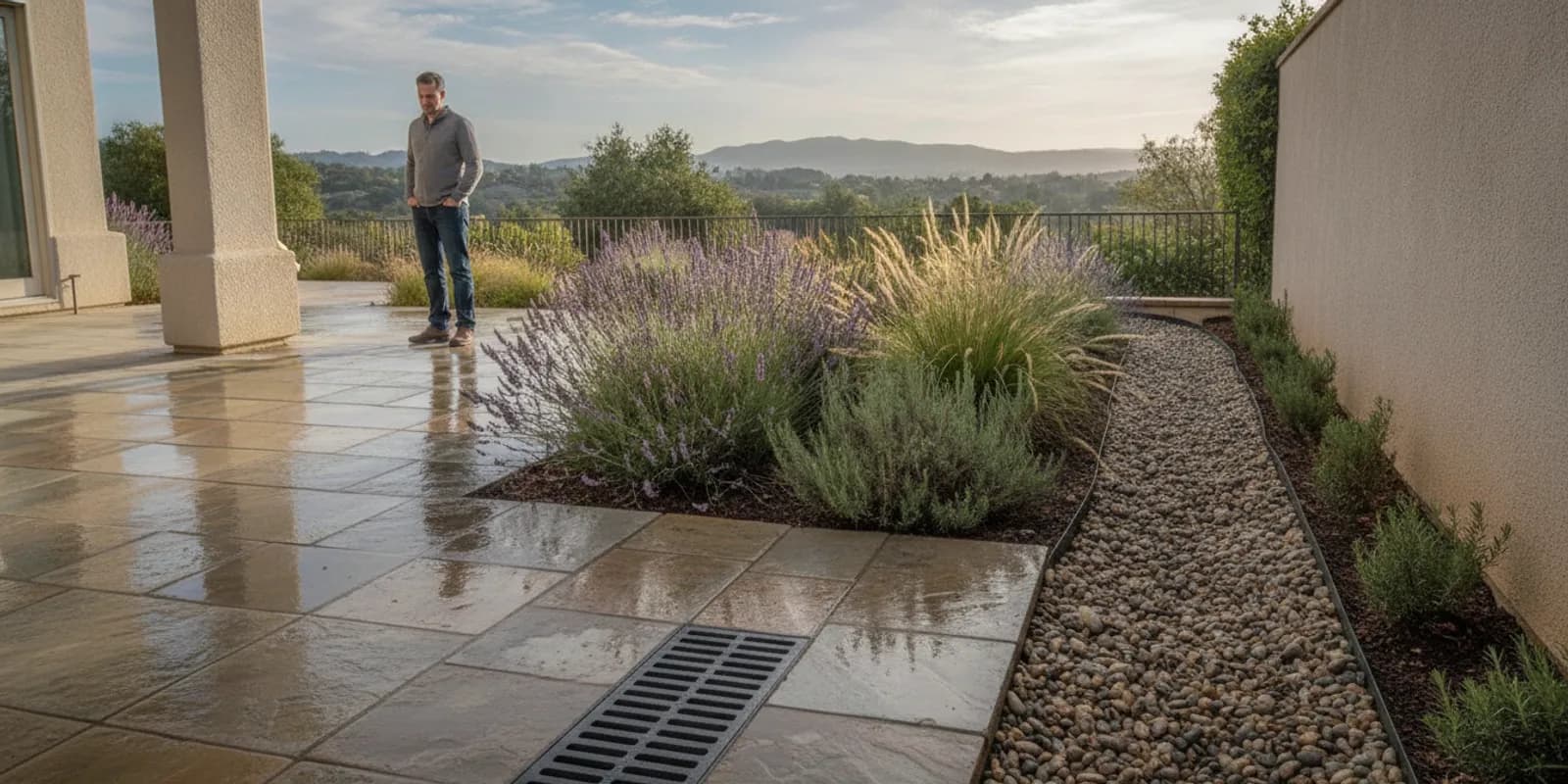
Choosing between a yard drain and French drain in Conejo Valley starts with a simple question: is water flowing across the surface, or collecting below ground? The right solution depends on where water comes from, where it needs to go, and what is happening in the soil and landscape. Here is how to compare common drainage options and what to check before installation or repair.
Request a drainage assessment today
What is the difference between a yard drain vs French drain in Conejo Valley?
A yard drain is usually a surface inlet connected to a buried pipe. A grate or basin collects water running across a paved or landscaped area, then the pipe carries it toward an approved outlet. The term can describe a small area drain at a low point, a channel drain beside a hardscape, or a broader yard-drain system.
A French drain is a subsurface drainage trench. It typically uses gravel and a perforated pipe to collect and move water within the soil. Instead of catching a sheet of runoff at a grate, it addresses water that seeps through or remains in the ground near the trench. The system needs an appropriate route and discharge point to work as intended.
A pop-up emitter is not a collection drain by itself. It is an outlet fitting at the end of a solid drain line. Water pressure can lift its cap while the system is discharging; when flow stops, the cap closes. It may be one part of a yard-drain system, but it does not solve a problem unless water can enter the system and the line can carry it to a suitable outlet.
| Option | Where it collects water | Common role | What to verify |
|---|---|---|---|
| Surface yard or area drain | At a low point on the ground or hardscape | Captures visible runoff before it spreads or ponds | Inlet location, grate condition, pipe route, and outlet |
| Pop-up emitter | At the end of a buried solid line | Releases collected water at a designated discharge point | Line flow, outlet location, and whether water can drain away |
| French drain | Below the surface, through gravel and perforated pipe | Intercepts water moving through or accumulating in soil | Soil conditions, trench route, depth, and a suitable outlet |
| Combined system | Surface inlets and/or subsurface trench | Addresses more than one water path | How components connect and whether the whole route functions |
These names describe different parts of drainage, but a property may need more than one approach. For an overview of the company’s yard drain and area drain services, see the service page.
When does a surface yard drain make sense?
A surface inlet may be worth investigating when rainwater runs across a patio, driveway, walkway, or lawn and gathers in a low spot. It can also help when runoff repeatedly reaches a doorway or a paved area is slow to clear. The important clues are visible flow patterns: where water starts, which direction it travels, and where it pauses.
Look at the site during or just after a rain, if it is safe. Note whether water flows toward the house, pools around a drain grate, or moves past the inlet. Take photos from a few angles. A drain set above the low point may miss the water; one placed in the path of debris may clog quickly. Leaves, soil, and landscape material can also cover the grate or enter the line.
Surface systems work only if their connections and outlet work too. If a basin fills but water does not move away, the issue may be a blocked, damaged, poorly sloped, or disconnected pipe, or a downstream outlet that cannot accept flow. Clearing or replacing one visible grate will not resolve a problem deeper in the route. A professional inspection can help trace the system before repair work begins.
Some homes also have a pool or hardscape with its own water-management needs. A pool deck drain is different from a yard inlet in its setting and layout; review the pool drain service information if water is gathering around that area. For household drainage services, the drain cleaning and drainage page explains related options.
When could a French drain be the better fit?
A French drain may be considered when water appears to move through the soil rather than simply running across the surface. Clues can include persistently soggy ground, water emerging along a slope, or moisture gathering at the base of a landscaped area. These signs do not prove that a French drain is needed. Irrigation leaks, roof runoff, plumbing leaks, and grading can create similar symptoms.
A French drain must be designed for the conditions at the property. Soil type affects how quickly water moves. The trench location and depth affect what it intercepts. The pipe needs a route that allows water to reach an outlet, and that outlet must be appropriate for the property and local requirements. A trench that ends in a place where water cannot disperse may shift the wet area rather than solve it.
French drains are not a substitute for correcting every source of water. If a downspout pours against the foundation, roof runoff may need to be handled at its source. If water flows toward the house because of the surface grade, correcting the grade or managing surface runoff may be part of the solution. If the dampness is caused by a plumbing leak, a landscape drain is not the repair.
A hydrology and water-quality review from San Diego State University discusses French drains and other measures used to manage surface water and support groundwater recharge. The document is a useful reminder that drainage decisions involve both where water is collected and where it goes: read the hydrology and water-quality discussion.
How do you choose between a yard drain vs French drain in Conejo Valley?
Start by identifying the water path rather than selecting a product first. A useful inspection looks at the whole route from source to outlet. It should consider whether the water is surface runoff, subsurface seepage, or a combination, and whether the existing drainage features are clear and connected.
- Record when and where water appears. Note whether the concern happens during rain, after irrigation, or even in dry weather. Mark the wettest area and any visible flow path.
- Check nearby sources. Look for roof downspouts, irrigation heads, hose bibs, pool areas, and plumbing fixtures that could add water. Do not assume all wet soil is rain runoff.
- Inspect existing inlets and outlets. Look for a covered grate, standing water, debris, or a pop-up outlet that does not open or discharge. Do not enter a drain or dig before checking for buried utilities.
- Follow the route. Determine where the line appears to go and whether the outlet is clear and located appropriately. If the route is unknown, a camera inspection may help assess an accessible drain line; see drain camera inspection information.
- Match the system to the water. Surface runoff may point toward a catch basin or channel inlet. Water moving through soil may call for a different investigation, potentially including a French drain. Multiple sources may require a coordinated design.
- Confirm the plan before work. Ask what problem the proposed work addresses, how water will reach the outlet, and what happens if the outlet is blocked or the soil does not drain as expected.
In Conejo Valley, properties vary in slope, soil, hardscape, landscaping, and existing utility routes. A solution that works in one yard may not suit the neighboring property. Inspection is especially important before adding a trench or connecting a new line to an existing drainage system.
What should an inspection check before installation or repair?
An inspection should connect the visible symptom to the system that may be causing it. Ask the technician to explain what was observed and distinguish confirmed findings from possibilities. Useful questions include:
- Does water flow over the surface, accumulate in the soil, or appear to come from a plumbing or irrigation source?
- Where is the low point, and is the existing inlet positioned to collect water there?
- Is the grate, basin, channel, or pipe obstructed or damaged?
- Can the line be traced to its outlet, and does water discharge as expected?
- Would a surface drain, subsurface drain, grading change, source correction, or combination address the cause?
- Are there buried utilities, property boundaries, public areas, or permit considerations that affect the route?
If a drain is backing up or there is a concern about a damaged underground line, a technician may need to assess the line rather than recommending a new landscape trench immediately. Conejo Bros Plumbing provides drain and sewer services in the area; see its Thousand Oaks service information and sewer inspection and repair page for related work.
Before approving a proposal, ask for a clear explanation of the collection point, pipe route, outlet, and maintenance needs. You can also ask what evidence supports the recommendation and what alternatives were considered. The company’s service information and pricing page is available for general reference; the right scope depends on the property and findings.
How do pop-up outlets fit into a yard drainage plan?
A pop-up emitter can provide a visible discharge point for a buried solid pipe. It may be useful where a line carries water away from an inlet, but it is only one component. The system still needs a properly placed collection point, an unobstructed path, and an outlet location that does not send water toward a building, neighboring property, or an area where it creates another hazard.
Check the emitter after rainfall if it is safe to do so. If the cap stays closed while water ponds upstream, the line could be blocked, the outlet could be buried, or the flow may not be reaching it. If it opens but water immediately collects nearby, the discharge area may not be suitable for the volume or soil conditions. Surface observation can identify symptoms, but it cannot always confirm the condition of a buried pipe.
Keep leaves, mulch, and soil away from the outlet. Avoid covering it during landscaping. If the outlet is damaged or the problem keeps returning, have the route evaluated rather than repeatedly clearing the same spot without finding why water is not moving.
What drainage problems may involve public works?
Not every drainage concern is limited to a private yard. Water or a damaged line near a street, sidewalk, or public utility may involve the Department of Water and Power (DWP), city public works, or another responsible agency. Property owners should not assume they can alter a public connection or discharge water onto public property. Confirm who owns the line and which agency or permit process applies before work starts.
Conejo Bros Plumbing also identifies public-works-related capabilities that may matter on larger or more complex projects: DWP and city public works coordination, street-lateral replacement, traffic control, City planning and permits, septic-to-city-sewer rerouting, and pre-construction plumbing bids. See the public works specialist information for these project types. A yard drainage inspection can help clarify what is on the property, but public infrastructure work requires the appropriate planning and approvals.
How can you compare the next steps?
Use this quick guide to organize what you observe. It is not a substitute for site-specific inspection, but it can help you explain the issue clearly when requesting help.
| What you notice | What to investigate | Questions to ask |
|---|---|---|
| Rainwater sheets across pavement or pools at a low spot | Surface grade, inlet position, grate, and connected line | Can the inlet capture the flow, and where does its pipe discharge? |
| Wet soil or seepage persists below the surface | Water source, slope, soil conditions, and subsurface route | Is seepage confirmed, and would a subsurface system address it? |
| A basin fills or a pop-up outlet does not discharge | Blockage, pipe damage, connection, slope, or outlet condition | Can the line be traced or inspected before replacement? |
| Water appears near a street or public utility | Ownership, responsible agency, access, and permitting | Does this involve DWP, city public works, or a street lateral? |
| More than one area stays wet | Multiple sources and how the systems interact | Will one fix address the cause, or are coordinated steps needed? |
For service details, start with the relevant area drain information or contact the team to describe where water collects and when it occurs. Photos, a rough sketch, and notes about recent rain or irrigation can make the first conversation more useful.
Request an inspection and discuss your drainage options
Frequently asked questions
Is a yard drain the same as a French drain?
No. A yard drain commonly collects visible surface runoff at a grate or basin. A French drain is a subsurface trench system intended to collect water moving through the ground. The terms are sometimes used loosely, so ask what components a proposed system includes.
Does a pop-up emitter remove water from a yard by itself?
No. It is an outlet at the end of a drain line. The system still needs a way to collect water, a clear route, and an appropriate place for discharge.
Can a French drain fix every soggy lawn?
No. Soggy ground can result from irrigation, roof runoff, grading, a plumbing leak, or soil conditions, among other causes. Identify the source before deciding whether a French drain or another correction is appropriate.
Should a yard drain connect to a sewer line?
Do not assume a yard drain should connect to a sewer. The acceptable discharge route depends on the system, local requirements, and site conditions. Have the proposed route checked before connecting or redirecting water.
What should I share when I request a drainage inspection?
Describe where water collects, when it appears, whether it happens after rain or irrigation, and whether there is an existing grate, channel, or pop-up outlet. Photos and a simple sketch can help explain the area.
Contact Conejo Bros Plumbing to discuss your drainage concern
The best drainage plan follows the water from its source to a suitable outlet, so inspection should come before choosing a system.