
Area Drain Sizing for a Pool Deck
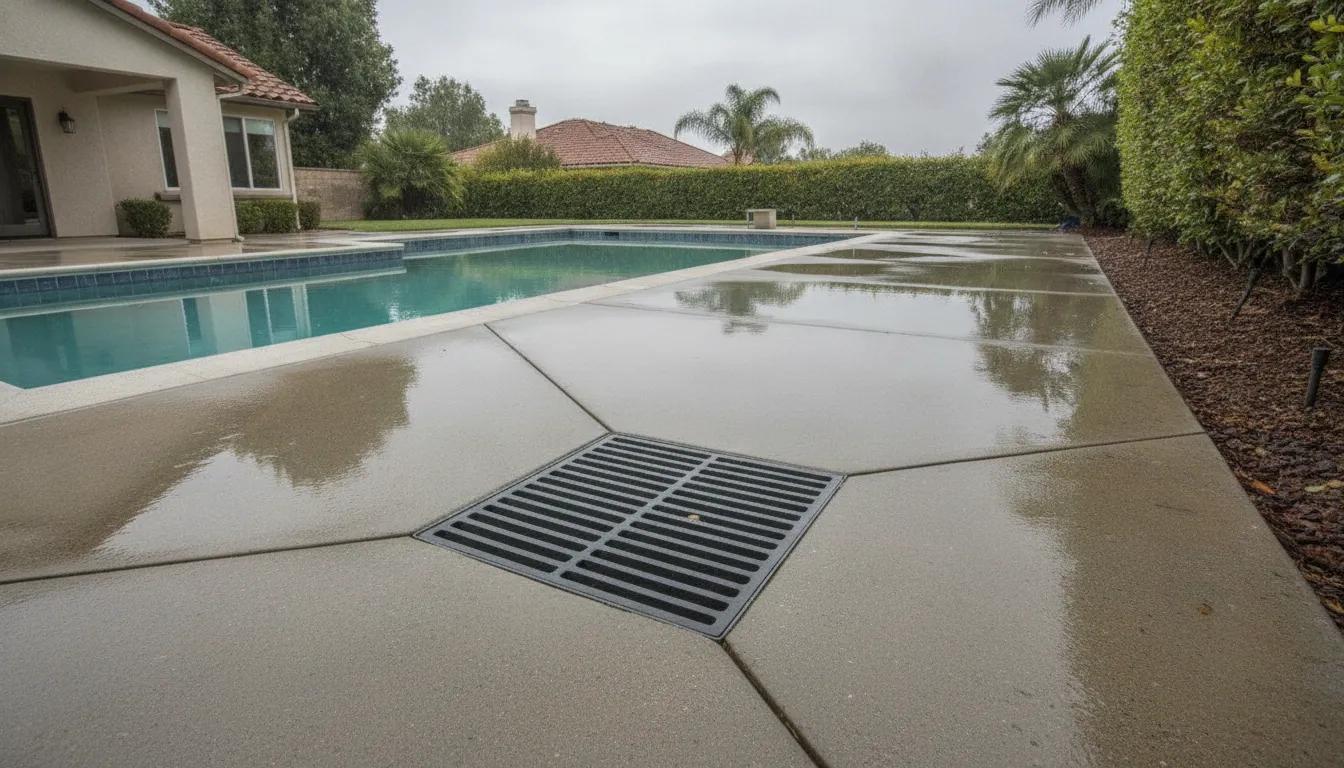
An area drain on a pool deck is only as useful as the water it can take in during a hard Conejo Valley storm. Size it before the concrete is poured. After the deck is finished, a grate that is too small, a pipe that is too flat, or an outlet that is already full is expensive to fix. The right size starts with the deck you have, not with a grate that looks tidy in a catalog. When those facts are written down, area drain installation can follow the water instead of a catalog photo.
Request an area drain review today
This guide walks through the site facts that change capacity. It is not a substitute for a licensed design when the city or the county asks for one. Conejo Bros Plumbing is based in Thousand Oaks and installs pool-area drainage across Conejo Valley and Ventura County. We look at elevations, runoff, and the discharge point before we recommend a grate or a pipe.
What an area drain has to handle on a pool deck
An area drain is a surface inlet. Water crosses the deck, drops through a grate or a slot, and leaves through a buried pipe. On a pool deck it may be a square grate, a round grate, or a long channel set in the concrete. The name on the box does not tell you whether it can keep up with a storm.
Three limits decide that, and the smallest one wins:
- Inlet. The open area of the grate, and whether leaves or pool debris can cover it.
- Pipe. Diameter, slope, and how many turns sit between the grate and the outlet.
- Outlet. Where the water is allowed to go once it leaves the deck.
A wide grate on a pinched pipe still ponds. A generous pipe that dumps into a full planter or a clogged curb line still ponds. Sizing means matching all three to the water that actually reaches that spot.
Pool decks add a twist that a lawn drain does not. The surface is hard, so almost all of the rain runs off instead of soaking in. Furniture, toys, and planter soil land on the grate. The water also has to leave without crossing a walkway or the neighbor's yard.
Measure the area drain tributary before you pick a grate
Start with the area that drains to this inlet, not the whole lot. Sketch the deck and mark the high points. Water runs downhill from those ridges. Everything uphill of the grate, and nothing past the next high spot, is the tributary for that one drain.
Include more than the concrete:
- The pool deck and any coping that sheds onto it.
- A patio, walkway, or sport court that slopes toward the same grate.
- A roof or patio cover whose downspout lands on the deck.
- A slope or planter above the deck that sends sheet flow across the edge.
Leave out surfaces that already drain somewhere else. A roof that goes to its own downspout line is not part of this inlet. A side yard that falls toward the street is not either. Adding those square feet makes the drain look undersized when it is not.
Measure in feet and multiply length by width for each piece. A 20-by-30-foot deck is 600 square feet. A 10-foot patio cover that also lands on that deck can add another few hundred. Write the pieces down. A single "about 800 square feet" guess hides the downspout that doubles the load.
Two grates split the load only if the deck is pitched so each one gets its own share. If the whole slab falls toward one corner, that corner inlet owns the deck. The second grate is a spare, not a partner.
How deck slope changes area drain size
Slope decides both where water goes and how fast it arrives. A pool deck should fall away from the house and away from the waterline toward a collection line. If it is nearly flat, water sheets across a wide area and arrives late, but it also sits. If it is steep, a smaller patch of deck can dump a lot of water on one grate in a short burst.
Look for these patterns before anyone orders parts:
- One low corner. Common on older decks. One area drain has to take the whole slab.
- A valley through the middle. A channel drain along that line often fits better than one square grate.
- Water toward the house or the pool. The inlet location is wrong even if the grate is large. Fix the pitch in the design, not with a bigger box.
- A raised bond beam or coping. It can trap a thin sheet of water that never reaches the grate you planned.
Conejo Valley lots are often sloped, and many sit on clay that does not drink water quickly. A deck that seems fine in a light shower can still send a sheet across the slab when a storm stacks on soil that is already wet. We study how surface water moves across the pool area before we match a drain to the deck.
Do not guess the fall with your eye alone. A long level, a string line, or a simple laser tells you which way the finished surface will go. If the deck is not poured yet, this is the cheap moment to move a grate. After the pour, moving it means cutting concrete.
Match the area drain inlet to debris and foot traffic
Capacity on paper and capacity on a Saturday afternoon are different. Pool decks collect leaves, seed pods, grass, sunscreen bottles, and grit from planters. A grate with a pretty open area can still go blind if the slots are narrow or sit flush where debris mats down.
Think about the inlet in four practical ways:
- Open area. More open metal moves more water, until heels, paws, and small toys become the problem.
- Slot shape. Long slots clog differently than small holes. Look at what actually falls on this deck.
- Traffic. A grate in a walkway needs to sit flush and feel secure underfoot. A grate in a planter edge can be coarser.
- Cleanout access. Someone has to lift or flush this inlet later. A grate no one can open is a future backup.
On our pool drain work, the inlet type follows the problem. A square or round area drain fits a low spot. A linear channel fits a wide paved run where water spreads out. A perimeter drain intercepts water traveling along the pool edge before it reaches the deck or a nearby wall. A pop-up emitter is an outlet in the landscape, not the inlet in the concrete.
If you already have a drain that ponds only after debris season, sizing may not be the failure. Our guide to pool deck drain backups covers restricted grates, pipes, and slope changes on an existing deck. Use this page when you are still choosing the inlet.
Check the pipe and the outlet, not just the grate
The pipe is where many pool-deck drains quietly fail. A grate can accept a burst that a long, flat, or twisting pipe cannot carry away. Water then rises in the inlet and looks like a grate problem.
Ask these questions before the trench is closed:
- What diameter is the lateral, and does it stay that size to the outlet?
- Does the pipe keep falling, or does it go flat under the deck?
- How many elbows are there? Each hard turn steals capacity.
- Is there a cleanout you can reach without cutting the deck later?
- Does this line join a yard drain, a downspout, or a curb outlet that is already busy in the same storm?
Sharing a line is not free capacity. A roof downspout and a deck drain peaking in the same cloudburst can fill a pipe that looked fine on its own. If the outlet is a pop-up in a flat lawn, the lawn may hold water before the deck grate does. If the outlet is the street, the curb inlet and any city connection still have to accept the flow.
Design rainfall is not one number for every lot. The National Weather Service office in Oxnard publishes local climate records for Ventura County, including rainfall, through its Los Angeles and Oxnard climate plots. A homeowner page cannot replace a city or county design calculation. It should remind you that a 4-inch pipe is not a size until slope, length, and the local storm are in the picture.
When the deck is part of a larger yard plan, read the yard drainage installation guide next. It covers how a system is laid out beyond a single pool grate. For standing water away from the pool, the standing-water drainage article is the better fit.
A simple area drain sizing check before you build
Use this as a planning check, not as an engineered design. It shows which fact is missing before you pour.
| Site fact | What to write down | If you skip it |
|---|---|---|
| Tributary area. | Square feet of deck, cover, and uphill slope that reach this inlet. | The grate is sized for a postcard corner, not the whole slab. |
| Deck slope. | Which way the finish falls, and whether one spot collects everything. | A second drain is installed where water never goes. |
| Inlet type. | Grate, channel, or perimeter drain, plus debris and foot traffic. | Open area looks fine until leaves mat the slots. |
| Pipe run. | Diameter, slope, length, elbows, and a reachable cleanout. | The inlet accepts water the pipe cannot take away. |
| Outlet. | Pop-up, planter, curb, or shared yard line, and who owns that discharge. | The deck is dry until the outlet is full. |
| Local storm. | Whether the city or county expects a design storm for this work. | A light-rain test passes and the first real storm does not. |
Bring that list to the bid. The installation page covers process and cost once the deck facts are known. This page stops at the decision of what the deck needs.
A few local details belong in the same conversation. We are based at 1386 Del Verde Ct in Thousand Oaks. Pool and yard drainage is work we do across the Conejo Valley, not a side note on a general plumbing call. Financing for qualifying projects can run through GreenSky or Synchrony. If the work touches a street lateral, a city main, or a public right of way, ask about permits and traffic control up front. That is public-works coordination. It is separate from a private deck grate.
After the system is in, keep it on a maintenance rhythm. Debris season and the first big rain are the tests. Our drainage maintenance guide covers what to check so a correctly sized inlet does not fail because nobody lifted the grate.
Book an area drain sizing visit now
Frequently asked questions
How do I size an area drain for a pool deck?
Add up only the surfaces that drain to that inlet, then match the grate, the pipe, and the outlet to that load. Include downspouts and uphill sheet flow. Do not add roof or yard area that already goes somewhere else.
Is a bigger area drain grate always better?
No. A larger grate can still fail if the pipe is flat, the outlet is shared, or leaves cover the openings. On a walkway, a very open grate can also be uncomfortable underfoot.
Can one area drain serve the whole pool deck?
Yes, if the finished slope sends the whole deck to that spot and the pipe and outlet can carry the peak. If the slab falls two ways, one drain will not see half the water.
Should I test the area drain with a hose?
A hose shows where water wants to go. It does not copy a cloudburst on a wet Conejo Valley lot. Use it to confirm slope and a clear outlet, then size for the storm, not for the hose.
When should I call before the deck is poured?
Call when the tributary is large, a downspout shares the line, the outlet is unclear, or the city asks for a drainage plan. Moving a grate after the pour means cutting concrete.
Book an area drain sizing consultation now
Planning the inlet before the pour is the cheap moment to get this right. Match the grate, the pipe, and the outlet to the water this pool deck will actually see.