
Rainwater Drainage for Sloped Driveway
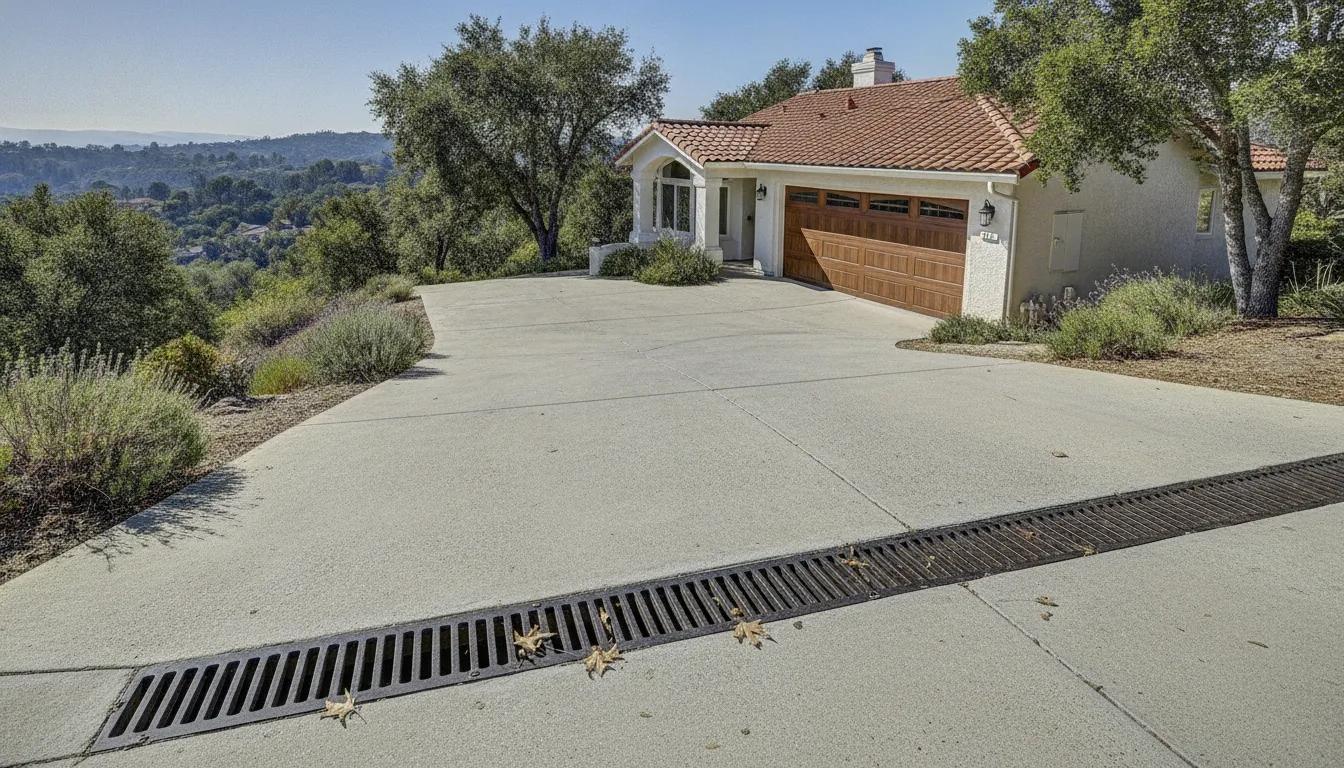
A sloped driveway does not store rain. It sends that sheet somewhere specific. Rainwater drainage for sloped driveway works when water crosses the pavement, drops into a channel, and leaves through an outlet that sits lower than the driveway. The exit should stay clear of the garage, the house, and a neighbor's lot. If any part of that path is blocked, missing, or pointed the wrong way, the next storm will show it at the threshold or along the low edge of the concrete.
See how yard drain service fits a sloped driveway
This is a pre-storm look at the route, not a repair menu. Walk the driveway while it is dry, or right after a light sprinkle, and write down what you see at the grate and the exit. Conejo Bros Plumbing is a locally owned drain and sewer team based in Thousand Oaks. We look at grade, hardscape, and the existing outlet before we recommend a next step. If the path is not safe, request a yard drain quote and we will take it from there.
How Does Rainwater Drainage for Sloped Driveway Work?
Picture the driveway as a broad roof you can drive on. Concrete and pavers shed water instead of soaking it up the way soil would. On a slope, that sheet of water gathers speed and heads for the lowest edge of the concrete. A useful path has three parts you can see without digging: the surface that aims the water, the channel that catches it, and the outlet that lets it leave.
The surface should tilt toward the channel, rather than toward the garage door, a side door, or the house wall. A channel is the long grate or open slot set across or along the low side of the pavement. Water should enter the grate across its length, rather than pile up beside it. The outlet is the point where that collected water comes out of the system. It should sit lower than the channel so gravity can do the work. It should discharge on your property or into an approved point. It should not sheet across the sidewalk or into a neighbor's yard.
The California State Water Resources Control Board explains that water running down driveways and streets enters a storm drain and can reach a lake, river, or the ocean without treatment. That public system is different from the pipe under a kitchen sink. Keeping oil, yard clippings, and hose water off the driveway protects that public stormwater path. It also keeps your own channel from filling with fine grit. Their plain explanation is here: what stormwater is and where driveway runoff goes.
If your driveway already has a grate, you are checking whether that grate still owns the true low line. If it does not, water will find the garage, the planter, or the public gutter on its own during the first heavy burst. Either result is a reason to look closer before the storm, rather than after the water is already inside.
Hill lots around Thousand Oaks change quickly from one parcel to the next. A short, steep apron moves water fast, while a flat spot in front of the garage lets it stall. Both can fail the same way if the channel is not sitting on the true low line. The same pre-storm look applies for homes we serve in nearby Ventura County cities.
What Should You Check for Rainwater Drainage for Sloped Driveway?
Start at the grate, and lift nothing that is bolted, cracked, or too heavy to reset by hand without the right tools. You only need to see whether rainwater can enter the opening.
- Stand at the top of the driveway and look down the slope. Note whether the pavement falls toward the garage, toward one edge, or toward a grate.
- Find the channel. It may run across the driveway in front of the garage, along one side, or at the street apron.
- Look through the grate openings. Leaves, mulch, seed pods, and packed silt should not fill the slot from end to end.
- Check that the grate sits level with or just below the surrounding pavement. A grate that sticks up above the concrete lets water run past it.
- Look for a gap between the concrete edge and the grate frame. Water that slips under the edge never enters the channel at all.
- Walk the full length of the grate. A channel only works for the stretch that is actually open. One clogged end can send the rest of the sheet sideways toward the garage.
- Sweep loose debris off the pavement with a stiff broom. Do not hose the driveway into the street or the curb inlet.
A light sprinkle is a better test than a guess made from the dry pavement alone. If you can safely run a hose at the high end for one minute, watch where the sheet goes, then stop the hose. You want to see water reach the grate and drop in along the slot. You do not want a river in the gutter, or a test that washes oil and grit into the public storm drain.
Write down three things: where water enters, where it misses the grate, and whether the grate is buried, lifted, or broken along its length. Photos of the dry channel and of any stain line on the concrete help later when you ask for a quote. Stains, leaves stuck in a line, and a dirt fan below the garage are all signs the last storm already chose a path across the apron.
Homes around Thousand Oaks, Newbury Park, and Moorpark often sit on lots with a short, steep driveway apron. Our Thousand Oaks service area covers these hillside driveways. If the storm has already passed and you are documenting a soggy yard instead, the yard drain problems after rain guide is the separate next read. This page stays on the before picture.
What Should You Check at the Outlet?
The channel is only the front door of the route. The outlet is the exit for everything the channel collects. If the exit is buried, pinched, or higher than the driveway, water will stand in the grate and then spill over the low edge.
Walk to where the driveway water is supposed to come out. On many Conejo Valley lots that point is a small pop-up in a planter. It can also be an open pipe on a slope, or a connection noted when the house was built. You should see a clear mouth, a spot lower than the channel, and ground that can take a short burst without sending it straight back at the house.
Use this outlet check before the rain arrives:
- The outlet is visible. Soil, ivy, or a new planter has not covered it.
- The opening is lower than the channel at the driveway.
- Water from a cup poured at the grate does not sit there. If you can see the outlet, a small pour should show movement, not a pond in the grate.
- The discharge stays on your lot or at an approved point. It does not dump on a neighbor's patio or across a sidewalk in a sheet.
- The area below the outlet is not already soaked from the last storm.
- Nothing electrical, such as a garage outlet or a landscape light, sits in the path the water will take if the outlet is slow.
If you cannot find an outlet at all, stop the test before you add more water. A grate with no exit is only a holding tray. It will fill in the first heavy burst and overflow at the lowest edge, which is often the garage. That is the moment to ask for help rather than to dig along the pipe.
Also look at the street side. Some aprons send a share of water to the gutter on purpose. That can be fine when the sheet is thin and the gutter is the approved route. It is not fine when the whole driveway dumps at the sidewalk, ponds at the curb, or runs into a public inlet that is already packed with leaves. The public storm drain is not your private outlet, and it is not a place to flush debris from the apron.
During an actual storm, stay out of moving water. The National Weather Service says it is never safe to walk or drive into floodwater, because even shallow moving water can knock you down and can hide a damaged surface. Read the Turn Around Don't Drown guidance before you treat a flooded apron as something to inspect up close. Watch from a dry, stable spot, or wait until the water drops.
Which Driveway Water Path Is Safe?
A safe path means the route is predictable. You can point to the entry, the channel, and the exit, and a small test follows that same line. Unsafe means the water chooses the garage, the house, a neighbor, or a public inlet you are not supposed to load with driveway runoff.
| What you see | What it means before a storm | What to do next |
|---|---|---|
| Water reaches the grate and leaves at a lower outlet on your lot. | The route is doing its job. | Sweep the grate, keep the outlet clear, and recheck after the first rain. |
| Water runs past a grate that sits high or is full of leaves. | The channel is not on the low line, or the opening is blocked. | Clear only loose debris, photograph the miss, and ask for a look if it repeats. |
| The grate fills and does not drop. | The outlet is slow, buried, or missing. | Stop digging and request yard drain help before the storm. |
| Water sheets into the garage or against the house. | The slope is aimed at the building. | Keep doors closed, move storage off the floor, and call before heavy rain. |
| Water leaves onto a neighbor's yard or across the sidewalk in a sheet. | The exit is in the wrong place. | Do not extend the pipe yourself. Ask for a route that stays on your lot. |
A safe path can still need a cleaning before the next storm. Leaves on the grate are a maintenance item. A path you cannot explain is not a maintenance item. If the last two storms left a dirt line into the garage, treat that as the answer even if today's sprinkle looks mild.
Pool decks and side yards can add water to the same low corner. If your driveway shares an edge with a pool pad, read how pool drains are meant to take deck water. That keeps the extra sheet from being blamed on the driveway alone. Keep the two paths separate in your notes.
When Should You Ask for Yard Drain Help?
Ask for help before the storm if any of these are true. You cannot find the outlet anywhere on the lot. The grate fills and stays full. Water already enters the garage or touches the house. The exit lands on a neighbor's property. The channel is cracked, the grate rocks under a tire, or the same miss happens every rain. Those are not problems a broom can fix.
Conejo Bros Plumbing checks the way water moves across the property before we talk about work. On a yard drain visit we look at grade, hardscapes, landscaping, roof runoff, and the lines that already exist. Driveway water is one part of that larger picture. We are based in Thousand Oaks and serve nearby Ventura County communities. The team holds CSLB contractor license #1108756, with A and C-42 classifications, and we are owner-operated rather than a call-center brand. You can read how the company works on the about page.
Bring four facts when you reach out for a quote. Note where the driveway slopes, where the channel sits, and where water actually went last time. Add a photo of the outlet if you can see it from a dry spot. That is enough for a useful first conversation about the route. You do not need to name a product or dig up the pipe before that visit.
There is a separate guide if an existing yard drain backs up once the rain is already heavy: why yard drains back up during heavy rain. If the question is standing water in the lawn rather than the apron, use the standing water guide. If you are comparing a surface drain with a French drain for the yard itself, use the yard drain and French drain comparison. Do not stretch this check into a design article.
Request a yard drain quote today
What Should You Do the Day Before Rain?
Give the check about twenty minutes while the pavement is dry. Do it in daylight. Wear shoes with grip, because a steep apron is slick even when it looks dry.
Sweep the channel and the apron before the clouds build. Lift only loose leaves from the grate with a gloved hand. Leave packed silt and anything below the grate alone. Confirm the outlet is still visible and lower than the driveway grade. Move boxes, stored paper, and the car charger off the garage floor if water has come in before. Close the pedestrian door at the low side of the garage.
If a one-minute hose test is safe, run it at the top of the slope and watch. Then stop the hose. Sweep, do not rinse, any grit the test left behind. State stormwater guidance is to sweep driveways rather than hose them into the gutter, because that wash water is untreated on its way to a creek or the ocean.
Skip these moves while you wait for rain. Do not pry up a vehicle-rated grate with a bar. Do not pour a chemical opener into a yard channel. Do not add a flex pipe that dumps water on the neighbor. Do not block the grate to keep debris out, because that also keeps rain out. And do not assume a public inlet at the curb is allowed to take your whole driveway volume.
After the first real rain, walk the same line again from a dry spot. If the channel took the sheet and the outlet kept up, you have a working route for this storm. If the garage got a fan of silt or the grate was under water, that is the note to send with your quote request. Our drainage maintenance guide for Thousand Oaks covers the between-storm habits. Installation choices live on the yard drainage installation page. The service overview remains the yard drain service page.
A Moorpark cul-de-sac and a coastal Ventura lot will not share the same outlet, which is why we look at the property rather than selling one standard grate. Financing, when a job is larger than a simple visit, is available through GreenSky and Synchrony. We will say so only after the route is clear on the property.
Frequently Asked Questions
What is rainwater drainage for sloped driveway?
It is the route rain takes across the pavement, into a channel, and out at an outlet. On a slope the water will not sit still, so the route has to be aimed on purpose toward an outlet. A safe route misses the garage, the house, and the neighbor's lot entirely.
Can I tell if the channel works without a storm?
Yes. Look for a grate on the low line, an opening that is not packed with leaves, and an outlet you can find that sits lower than the driveway. A one-minute hose test at the top of the apron shows whether the sheet reaches the grate. Stop the test if water heads for the garage door.
Should driveway water go into the street drain?
Only if that is already the approved exit for a thin sheet, not as a place to dump debris. The State Water Board notes that driveway water entering a storm drain is not treated before it reaches a waterway. Sweep the apron clean. Do not hose mud into the gutter or the public inlet.
When is a sloped driveway a reason to call?
Call when you cannot find the outlet, the grate fills and stays full, water already reaches the garage or the house, or the exit lands on someone else's property. Also call if the grate is broken or the same miss happens every rain on that apron. Those points need a look from a local crew, not another sweep.
Does this check replace a repair plan?
No. This page is only the before-the-storm look at the channel and the outlet. It does not choose a repair for you. If the path is missing or pointed the wrong way, ask Conejo Bros Plumbing for a yard drain quote. We will inspect the grade and the exit before recommending work.
Request a Quote Before the Next Storm
If the channel misses the water or the outlet is nowhere to be found, do not wait for the garage to prove it. Conejo Bros Plumbing will look at the slope, the grate, and the exit, then tell you whether the route is sound. We are the local team in Thousand Oaks, available for homes across Ventura County, and we keep the first conversation practical.